For businesses operating across India's complex logistics network, choosing the right transportation mode can have a direct impact on delivery performance, operating costs, and customer satisfaction. Road transportation provides flexibility and door-to-door connectivity, air transportation offers speed, while rail parcel services can provide an additional option for eligible parcels moving between key markets.
This is where multimodal freight transport in India becomes valuable.
Multimodal transportation is not about using every available mode for every shipment. It is about selecting the most appropriate mode for each stage of a shipment's journey based on distance, urgency, parcel characteristics, cost, and service requirements.
For supply chain managers, procurement teams, manufacturers, retailers, and e-commerce businesses, this approach can create a more flexible and cost-conscious logistics network.
Why Businesses Are Moving Beyond Single-Mode Transportation
Using one transportation mode for every shipment may seem simple, but it does not always provide the best commercial outcome.
For example, long-distance road transportation can offer excellent flexibility but may involve higher fuel, toll, vehicle, and operational costs. Air transportation provides speed but can be expensive when used for shipments that do not require urgent delivery.
A better approach is to evaluate the complete logistics requirement.
Businesses should consider:
- Shipment size and weight
- Origin and destination
- Required delivery timeline
- Product value
- Route availability
- Handling requirements
- Shipment frequency
- Total transportation cost
- Pickup and final-mile requirements
This approach supports freight cost optimization by focusing on the total cost of moving a shipment rather than simply comparing individual freight rates.
Road Transportation: The Flexible Connecting Mode
Road transportation remains one of the most important components of India's logistics ecosystem.
Factories, warehouses, railway stations, airports, distribution centers, stores, and customers are rarely located at the same point. Road transportation provides the flexibility required to connect these locations.
Within a multimodal network, road can support:
- Customer pickups
- Factory-to-hub movements
- Warehouse transfers
- Railway station connectivity
- Regional distribution
- Final-mile delivery
This makes road transportation particularly valuable at the beginning and end of a multimodal journey.
A shipment can therefore use road transportation for local connectivity while another mode handles the longer intercity portion of the movement.
Rail Parcel Service: An Additional Option for Delhi–Mumbai
Rail parcel transportation should be clearly distinguished from conventional rail freight or bulk cargo transportation.
For eligible parcels moving between Delhi and Mumbai, passenger-train Parcel Vans can provide a scheduled transportation option on the Delhi–Mumbai–Delhi corridor.
The rail parcel service operates through Tejas Rajdhani Express and August Kranti Tejas Rajdhani Express, using the passenger train's Parcel Van for eligible parcel movement.
The practical model can be:
Customer Pickup → Road Transportation → Parcel Handling → Passenger Train Parcel Van → Destination Station → Road Delivery
This approach combines the flexibility of road transportation with scheduled passenger-train parcel movement for the intercity portion of the journey.
For businesses operating between Delhi and Mumbai, this can provide an additional option when evaluating delivery timelines, parcel characteristics, route requirements, and overall logistics costs.
Importantly, this service is rail parcel transportation through passenger Parcel Vans, not a conventional rail cargo or bulk rail freight service.
Where Air Transportation Fits
Air transportation serves a different purpose within a multimodal logistics strategy.
When delivery speed has a significant commercial impact, businesses may consider air transportation for selected shipments. These could include urgent products, critical spare parts, high-value goods, or time-sensitive consignments.
For example, if a manufacturing facility requires an urgently needed component to prevent production downtime, the cost of delay may be considerably higher than the additional transportation cost of air freight.
Therefore, businesses should not view air as simply an expensive transportation mode. Instead, it should be evaluated based on the business value of speed.
The right strategy is to use each mode where it delivers the greatest operational and commercial value.
How Multimodal Transportation Can Reduce Overall Logistics Costs
Transportation cost should never be evaluated only on the freight rate.
A company's actual logistics expenditure may include:
- Transportation charges
- Fuel-related costs
- Loading and unloading
- Handling charges
- Station or terminal costs
- Warehousing
- Inventory carrying costs
- Last-mile delivery
- Delay-related expenses
- Shipment exceptions
A multimodal strategy allows supply chain teams to evaluate these factors together.
For instance, an eligible Delhi-to-Mumbai parcel may be collected by road, moved through a passenger train Parcel Van, and delivered from the destination station by road. For another shipment, direct road transportation may be more appropriate. An urgent shipment may justify air transportation.
The best option depends on the specific shipment and logistics lane.
Connecting Transportation With Warehousing
Transportation and warehousing decisions are closely connected.
A shipment arriving too early can increase storage and inventory carrying costs, while a delayed shipment can result in stockouts, missed sales, or production interruptions.
This is why End-to-end supply chain planning should connect transportation decisions with inventory, warehouse capacity, demand forecasting, order fulfillment, and customer delivery requirements.
Modern warehousing / omnichannel retail operations make this even more important. Inventory may need to move between central warehouses, regional distribution centers, stores, and local fulfillment locations depending on customer demand.
Technology can provide greater visibility across these activities.
Role of Technology in Multimodal Logistics
Digital systems are increasingly helping logistics teams manage complex transportation networks.
AI & IoT in warehousing can support better visibility into inventory, shipment movement, warehouse activity, and operational performance.
Integrated logistics platforms can help teams monitor:
- Shipment status
- Transportation costs
- Delivery timelines
- Inventory position
- Capacity utilization
- Exceptions
- Route performance
This information enables decision-makers to identify delays, compare transportation performance, and make faster operational decisions.
For multimodal logistics, visibility becomes particularly important because a shipment may pass through several transportation stages before reaching the customer.
Supporting Faster Fulfillment Networks
The growth of e-commerce and changing customer expectations have increased the importance of faster fulfillment.
Micro-fulfillment / dark stores can help retailers position inventory closer to high-demand customer locations. However, localized inventory also creates additional transportation requirements.
A supply chain may therefore operate through a network such as:
Supplier → Central Warehouse → Regional Hub → Local Fulfillment → Customer
Different transportation options can be evaluated at each stage according to distance, urgency, shipment volume, and cost.
This allows businesses to balance delivery speed with financial efficiency instead of pursuing maximum speed for every order.
When Should Businesses Consider a 3PL?
Managing multiple transportation modes internally requires operational expertise, technology, carrier relationships, shipment visibility, documentation capabilities, and exception management.
Businesses may therefore consider 3PL and outsourcing logistics when they require specialized logistics capabilities without building an entire transportation infrastructure internally.
A logistics partner should be evaluated on more than freight price. Important factors include network capability, technology integration, operational experience, shipment visibility, scalability, reporting, and service reliability.
The right partner should help businesses optimize the overall logistics network rather than simply arrange transportation.
Measuring Multimodal Logistics Performance
A multimodal strategy should be continuously measured through relevant KPIs.
Businesses can track:
- Transportation cost per shipment
- Cost per kilogram
- On-time delivery rate
- Transit-time consistency
- Order fulfillment rate
- Vehicle utilization
- Shipment damage rate
- Handling time
- Exception frequency
- Customer complaints
These metrics help identify which transportation combinations are delivering the best balance of cost and service.
Conclusion
Multimodal transportation provides businesses with a practical way to balance logistics cost, delivery speed, flexibility, and reliability.
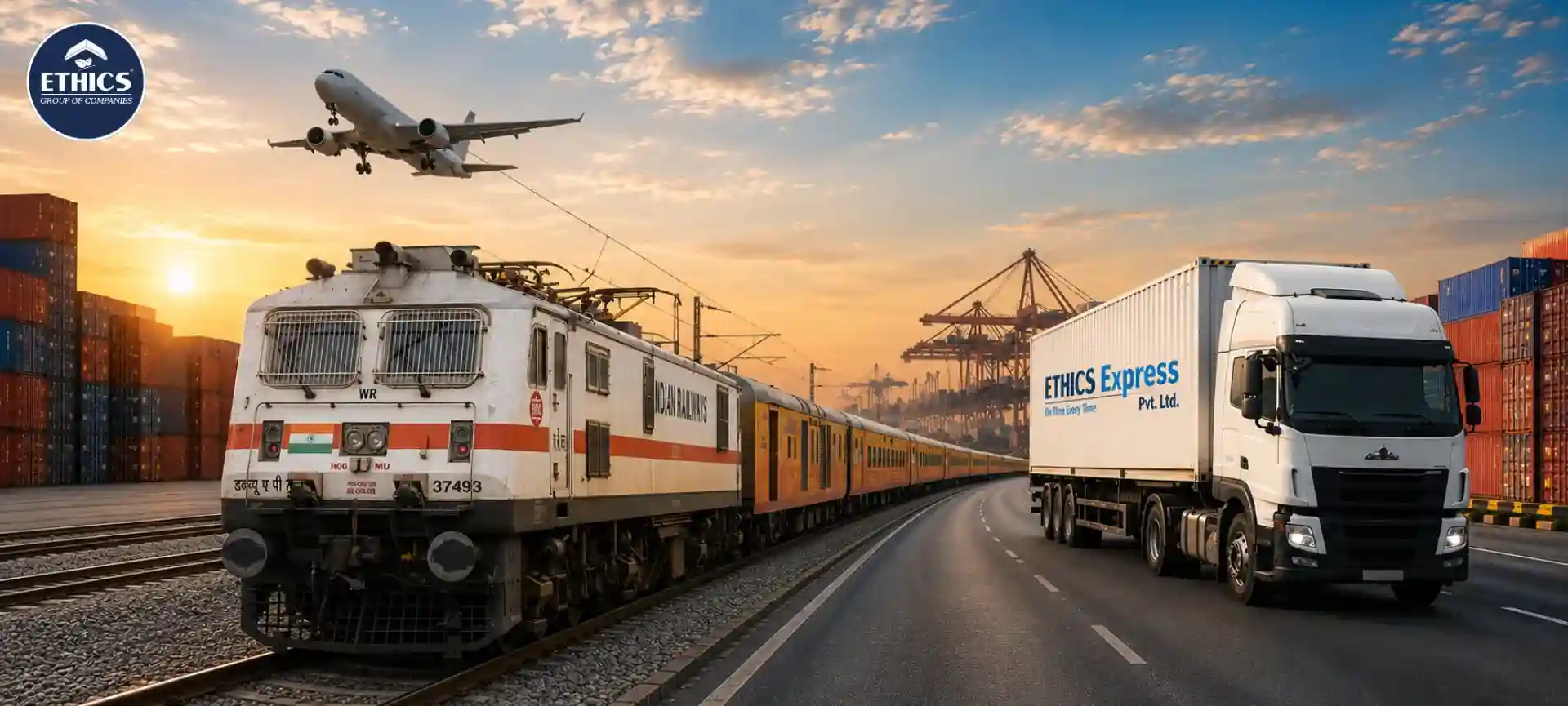
Road transportation offers essential pickup and delivery connectivity. Passenger-train Parcel Vans provide an additional option for eligible parcel movement between Delhi and Mumbai through Tejas Rajdhani Express and August Kranti Tejas Rajdhani Express. Air transportation can be considered when shipment urgency makes speed commercially valuable.
The objective is not to replace one transportation mode with another. It is to determine which mode is most suitable for each shipment and each stage of the logistics journey.
For businesses evaluating multimodal freight transport in India, combining transportation planning with technology, warehousing, fulfillment, and data-driven decision-making can create a more efficient and resilient logistics network.
By combining technology, road connectivity, passenger-train parcel services, air transportation where required, and disciplined logistics planning, Ethics Group can help businesses explore practical transportation solutions aligned with their shipment and service requirements.