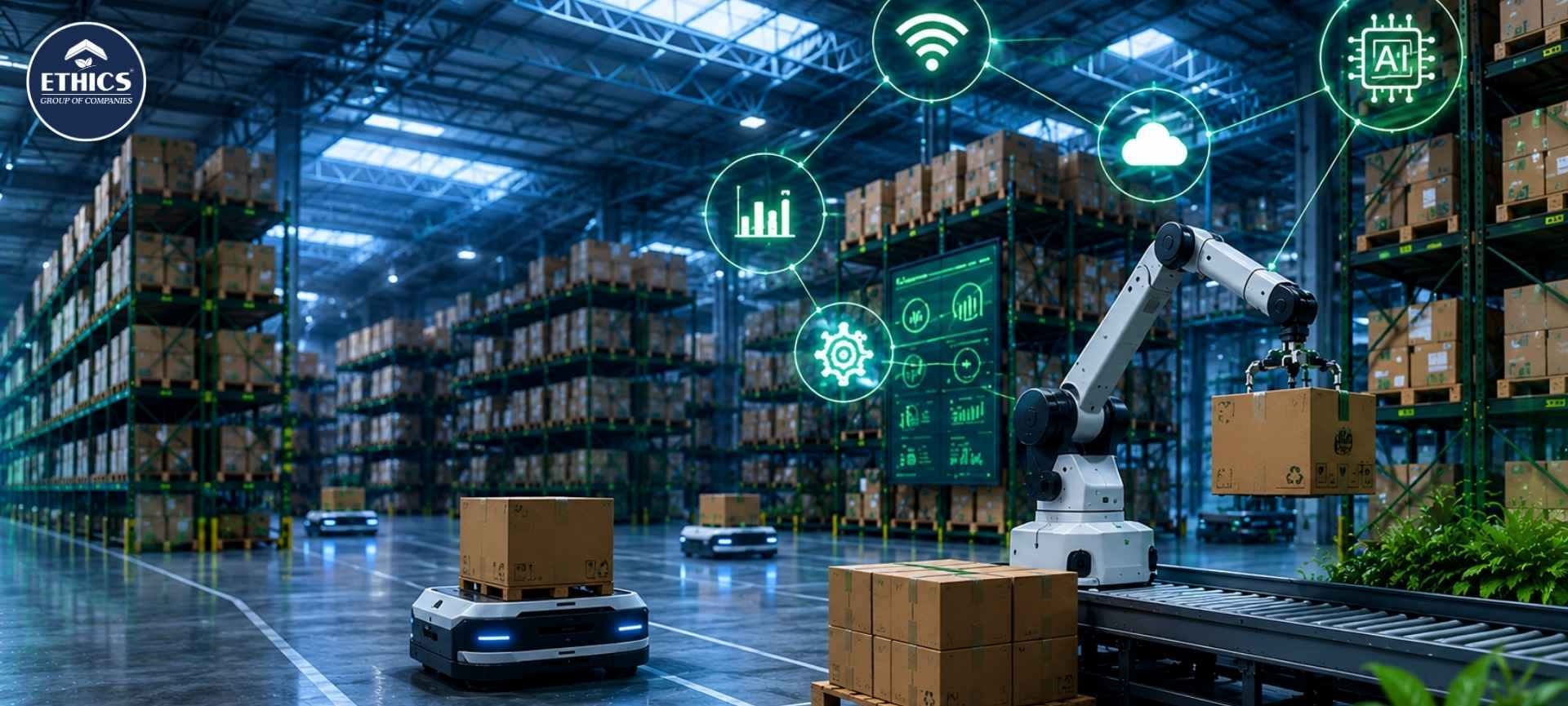
Warehousing has evolved from being a storage-centric function to becoming a strategic pillar of modern supply chains. Today's warehouses are expected to support faster order fulfillment, maintain inventory accuracy, improve customer service levels, and contribute to sustainability objectives—all while controlling operational costs.
As supply chains become increasingly complex, traditional warehouse management approaches often struggle to deliver the visibility, agility, and efficiency required in today's business environment. This challenge has accelerated the adoption of advanced technologies, particularly Artificial Intelligence (AI) and the Internet of Things (IoT).
Together, AI and IoT are reshaping warehouse operations by enabling real-time decision-making, predictive insights, intelligent automation, and resource optimization. Beyond operational performance, these technologies are helping organizations build more sustainable warehouse ecosystems that reduce waste, optimize energy consumption, and support long-term environmental goals.
For logistics providers, manufacturers, retailers, distributors, and third-party logistics companies, AI and IoT are no longer emerging technologies—they are becoming critical business enablers.
The Growing Challenges in Modern Warehousing
Warehouses today operate in an environment characterized by increasing customer expectations, rising operational costs, and ongoing labor challenges.
Some of the most common warehouse challenges include:
- Limited real-time inventory visibility
- Inventory inaccuracies and stock discrepancies
- Rising labor and operational expenses
- Space utilization inefficiencies
- Equipment downtime
- Increasing order volumes
- Sustainability and carbon reduction requirements
- Demand forecasting uncertainties
These challenges directly impact service levels, profitability, and customer satisfaction.
Organizations seeking long-term competitiveness must find ways to improve warehouse performance while reducing resource consumption and environmental impact.
Understanding AI and IoT in Warehousing
What is Artificial Intelligence in Warehousing?
Artificial Intelligence refers to systems capable of analyzing large volumes of operational data, identifying patterns, and making intelligent recommendations or automated decisions.
In warehouse environments, AI supports:
- Demand forecasting
- Inventory optimization
- Workforce planning
- Route optimization
- Predictive maintenance
- Automated decision-making
- Robotics and automation systems
AI enables warehouses to move from reactive operations to predictive and proactive management.
What is IoT in Warehousing?
The Internet of Things consists of connected devices, sensors, machines, and equipment that continuously collect and exchange operational data.
Common warehouse IoT applications include:
- RFID-enabled inventory tracking
- Smart shelving systems
- Environmental monitoring sensors
- Connected forklifts
- Asset tracking devices
- Energy management systems
- Automated storage and retrieval systems
IoT creates a real-time digital view of warehouse operations, enabling better visibility and control.
How AI and IoT Work Together
While IoT generates vast amounts of operational data, AI converts that data into actionable intelligence.
For example:
- IoT sensors detect inventory movement.
- AI analyzes movement patterns.
- The system predicts replenishment requirements.
- Warehouse managers receive proactive recommendations.
This combination creates an intelligent warehouse ecosystem capable of self-monitoring, self-optimizing, and continuously improving operational performance.
Key Applications of AI and IoT in Warehousing
1. Real-Time Inventory Visibility
Inventory accuracy remains one of the most critical warehouse performance metrics.
IoT-enabled sensors and RFID technology provide continuous inventory tracking throughout storage and movement processes.
AI analyzes inventory data to identify:
- Slow-moving stock
- Fast-moving inventory
- Replenishment needs
- Potential stockouts
- Overstock risks
This helps organizations improve inventory accuracy while reducing carrying costs.
Operational Benefit
Better inventory visibility reduces working capital requirements and improves customer order fulfillment rates.
2. Predictive Maintenance for Warehouse Equipment
Unexpected equipment failures can disrupt warehouse operations and create costly delays.
IoT sensors installed on material handling equipment continuously monitor:
- Temperature
- Vibration
- Usage cycles
- Operating conditions
AI algorithms analyze this data to identify early warning signs of equipment failure.
Instead of waiting for breakdowns, maintenance teams can schedule preventive actions before operational disruptions occur.
Operational Benefit
- Reduced downtime
- Lower maintenance costs
- Increased equipment lifespan
- Improved operational continuity
3. Intelligent Space Optimization
Warehouse space is one of the most valuable operational assets.
AI-powered analytics evaluate:
- Product movement patterns
- Storage utilization rates
- Picking frequency
- Inventory turnover
Based on these insights, warehouse layouts can be continuously optimized.
IoT devices provide real-time visibility into storage occupancy and utilization levels.
Operational Benefit
Organizations can increase storage capacity and improve picking efficiency without expanding facility footprints.
4. Enhanced Order Picking Accuracy
Order fulfillment accuracy directly influences customer satisfaction and operational efficiency.
AI-powered warehouse systems optimize picking routes based on:
- Order priority
- Warehouse layout
- Inventory location
- Workforce availability
IoT-enabled devices guide workers through optimized workflows, reducing manual errors and travel time.
Operational Benefit
- Faster order processing
- Higher picking accuracy
- Reduced labor costs
- Improved customer experience
5. Workforce Productivity Optimization
Labor shortages continue to challenge warehouse operations globally.
AI helps warehouse managers make better workforce decisions by analyzing:
- Productivity trends
- Shift performance
- Order volume forecasts
- Resource requirements
Connected devices provide visibility into operational workflows and worker efficiency.
Operational Benefit
Improved workforce planning helps organizations maintain service levels while controlling labor costs
Sustainability Benefits of AI and IoT in Warehousing
Sustainability has become a key strategic priority across supply chain operations.
Warehouse operators are increasingly expected to reduce energy consumption, lower emissions, and minimize waste.
AI and IoT contribute significantly to these goals.
Energy Optimization
IoT-enabled energy monitoring systems track:
- Lighting usage
- HVAC performance
- Equipment energy consumption
AI identifies inefficiencies and recommends optimization opportunities.
Result
Lower energy costs and reduced carbon footprint.
Reduced Waste and Excess Inventory
Excess inventory often results in:
- Product obsolescence
- Additional storage costs
- Increased waste
AI forecasting models improve inventory planning by analyzing historical demand patterns and market trends.
Result
Reduced inventory waste and improved resource utilization.
Efficient Resource Utilization
Smart warehouses optimize:
- Storage space
- Equipment usage
- Workforce allocation
- Transportation planning
Result
Improved operational efficiency with fewer resources.
Industry Use Cases
E-Commerce Fulfillment Centers
High-volume fulfillment environments use AI and IoT to:
- Accelerate order processing
- Improve inventory visibility
- Optimize picking routes
- Reduce fulfillment costs
The result is faster delivery performance and improved customer satisfaction.
Manufacturing Warehouses
Manufacturers use connected warehouse technologies to improve:
- Raw material visibility
- Production support logistics
- Inventory accuracy
- Equipment maintenance planning
This ensures smoother production operations and reduced supply disruptions.
Third-Party Logistics (3PL) Providers
3PL operators manage multiple clients, inventory profiles, and service requirements.
AI and IoT help by providing:
- Real-time inventory transparency
- Predictive resource planning
- Performance monitoring
- Automated reporting
These capabilities improve service quality while supporting operational scalability.
Operational Impact on Supply Chain Performance
The benefits of AI and IoT extend beyond warehouse walls.
Improved warehouse performance positively influences:
- Order fulfillment rates
- Inventory turnover
- Transportation efficiency
- Customer service levels
- Supply chain resilience
Organizations gain the ability to make faster, data-driven decisions while responding more effectively to market changes and customer demands.
The result is a more agile and responsive supply chain ecosystem.
Future Trends in Smart Warehousing
The next generation of warehouse operations will become increasingly autonomous and connected.
Key trends include:
AI-Powered Autonomous Warehouses
Advanced AI systems will make real-time operational decisions with minimal human intervention.
Digital Twins
Virtual warehouse models will simulate operational scenarios and support continuous optimization.
Advanced Robotics
Collaborative robots and autonomous mobile robots will further improve warehouse productivity.
Sustainability-Driven Automation
Technology investments will increasingly focus on reducing environmental impact while improving operational efficiency.
Hyper-Connected Supply Chains
IoT-enabled warehouses will become fully integrated with transportation, manufacturing, and distribution networks.
Organizations that adopt these innovations early will be better positioned to compete in an increasingly data-driven logistics landscape.
Conclusion
AI and IoT are transforming warehousing from a cost center into a strategic business asset. By enabling real-time visibility, predictive intelligence, automation, and sustainability-focused operations, these technologies help organizations improve efficiency while supporting long-term growth objectives.
As supply chains become more complex and customer expectations continue to rise, smart warehousing capabilities will play a critical role in operational success. Companies investing in intelligent warehouse technologies today are creating the foundation for more resilient, scalable, and sustainable supply chain operations tomorrow. Organizations such as Ethics Group are contributing to this transformation by supporting technology-driven logistics and warehouse modernization initiatives.