At Ethics Group of Companies, sustainability is not a separate initiative. It is built into how we design and operate supply chains, because the choices that make logistics efficient are very often the same choices that make it responsible. The mode used to move goods is one of the clearest examples of this principle at work.
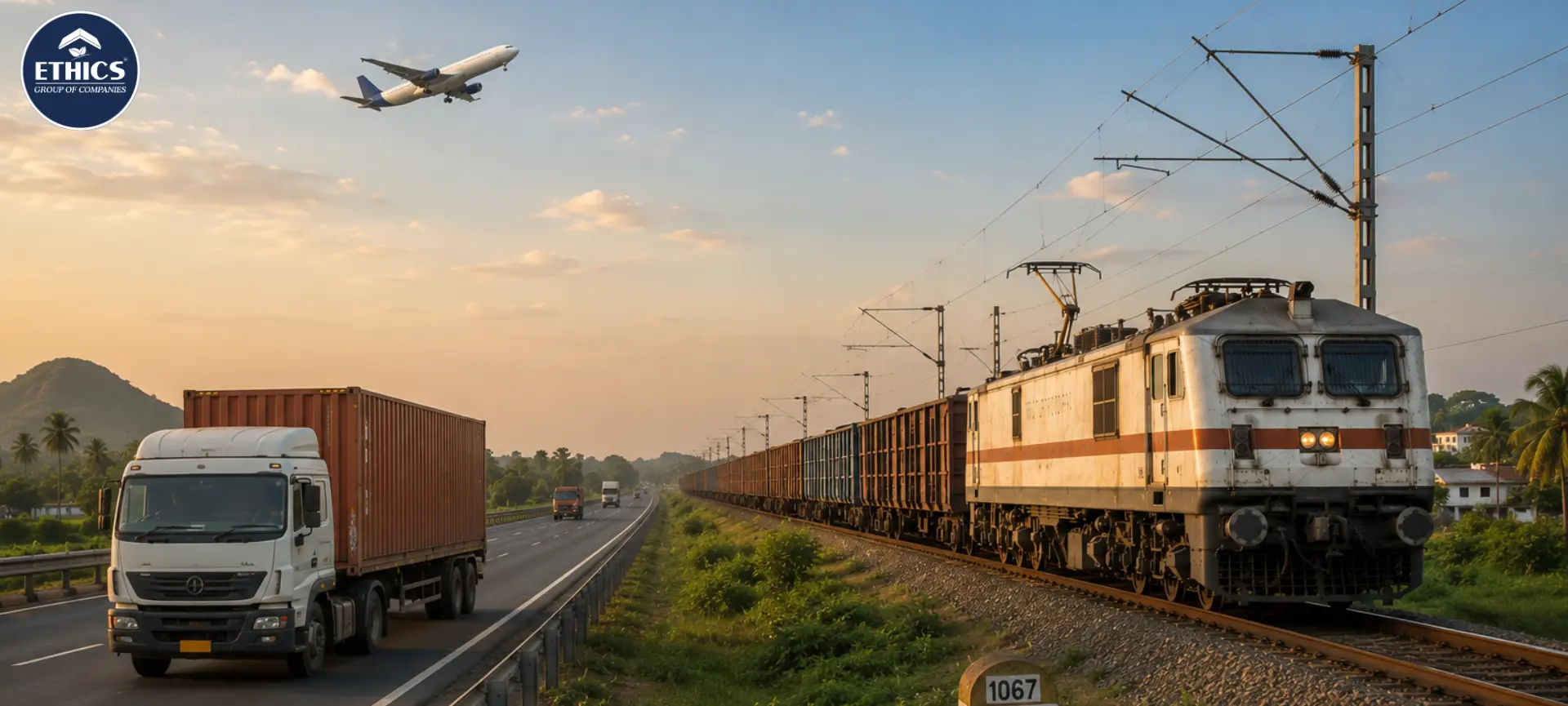
Cost and speed have long been the first questions in any transport decision. A third now sits alongside them, increasingly written into tenders and supplier scorecards: how much carbon does the shipment produce? On one of India's busiest lanes — Delhi to Mumbai — the answer changes dramatically with the mode chosen. Moving the same goods by air, by a 32-foot truck, or by rail produces very different emissions, and the gap is far wider than most assume. This article sets out those figures as transparently as the data allows, so that carbon can be weighed alongside cost and time.
Why mode choice is a sustainability decision
Every supply chain carries an environmental cost, and transport is among its largest contributors. The efficiency levers that reduce that cost are well understood — optimising routes and networks, planning loads to reduce empty runs, and improving asset utilisation. Mode selection sits above all of these. Choosing the right mode for a given lane can reduce the carbon of a shipment by an order of magnitude, before any other efficiency measure is applied. For a corridor as long and as heavily used as Delhi–Mumbai, that decision is one of the most consequential a business can make.
How the modes were compared
A comparison is only credible if the method is open, so here is precisely how these figures were built.
Emissions are expressed as carbon dioxide equivalent (CO2e) on a well-to-wheel basis, which counts both the energy used to produce the fuel or electricity and the energy used in the journey itself. The unit is grams of CO2e per tonne-kilometre — the carbon required to move one tonne of goods one kilometre. Multiplying that intensity by the corridor distance gives the carbon to move a tonne from Delhi to Mumbai.
The rail and road intensities used here are drawn from the India Default GHG Values published by the Smart Freight Centre with the TCI-IIMB Supply Chain Sustainability Lab at IIM Bangalore, which derive rail figures directly from Ministry of Railways fuel data and road figures from Indian freight-industry research. The air figure is based on widely used international air-freight factors, as India-specific air values are not published in the same dataset. These are representative modal averages, not the footprint of any single vehicle or service, and all results are estimates that vary with how fully a vehicle is loaded, the type of truck or aircraft, and the exact routing.
The numbers, side by side

Per tonne of goods carried over the corridor, the approximate carbon footprint is as follows.
| Mode | Approx. intensity | CO2e per tonne, Delhi–Mumbai |
|---|---|---|
| Rail freight | ~11 g per tonne-km | ~15 kg |
| Road — 32 ft truck | ~80–90 g per tonne-km | ~115 kg |
| Air freight | ~600–1,000 g per tonne-km | ~700–1,100 kg |
The pattern is unambiguous. A 32-foot truck emits roughly seven to eight times as much carbon per tonne as rail over this route — a like-for-like comparison, since both figures come from the same Indian dataset. Air freight is higher again by a wide margin, well over an order of magnitude above rail per tonne of goods. Rail's advantage comes from two factors working together: a train spreads its energy use across a very large load, and the majority of the Indian Railways network now runs on electric traction rather than diesel, which makes its measured intensity unusually low.
A note on interpretation: the rail and road values share one India-specific dataset, while the air value is drawn from international factors, so the rail-to-air multiple is indicative rather than exact. The absolute per-tonne figures, however, each rest on their own published basis.
What this means for a single shipment
Per-tonne figures can feel abstract, so it helps to consider one shipment.

A fully loaded 32-foot truck carrying around 15 tonnes from Delhi to Mumbai produces, by road, in the region of 1.7 tonnes of CO2e. Moving the same 15 tonnes by rail produces roughly 0.2 tonnes for the trunk run. Even after adding the short road legs at each end — which a rail movement always needs — the door-to-door total stays in the region of 0.3 tonnes, leaving a saving of around 1.4 to 1.5 tonnes of CO2e. That is for a single load on a single corridor. Across a year of regular movement, those savings compound rapidly, which is why a shift to rail is one of the most effective levers available for reducing supply-chain emissions without compromising service.
Reading the comparison responsibly
It would be misleading to present one mode as simply correct and the others as wrong. Each has a legitimate role.
Air freight earns its carbon cost when speed is non-negotiable — an urgent medical consignment, or a critical part where delay is far costlier than the emissions. Road is indispensable for door-to-door movement, shorter distances, and locations not served by a rail terminal; indeed, rail almost always relies on short road legs at each end to complete the journey to the door. The responsible conclusion is not that road and air have no place, but that for regular, planned, high-volume movement between two well-connected metros, rail is decisively the lowest-carbon backbone. Using it for the long trunk, with road completing the ends, captures most of the saving while preserving full reach.
Sustainability in action: rail on the Delhi–Mumbai corridor
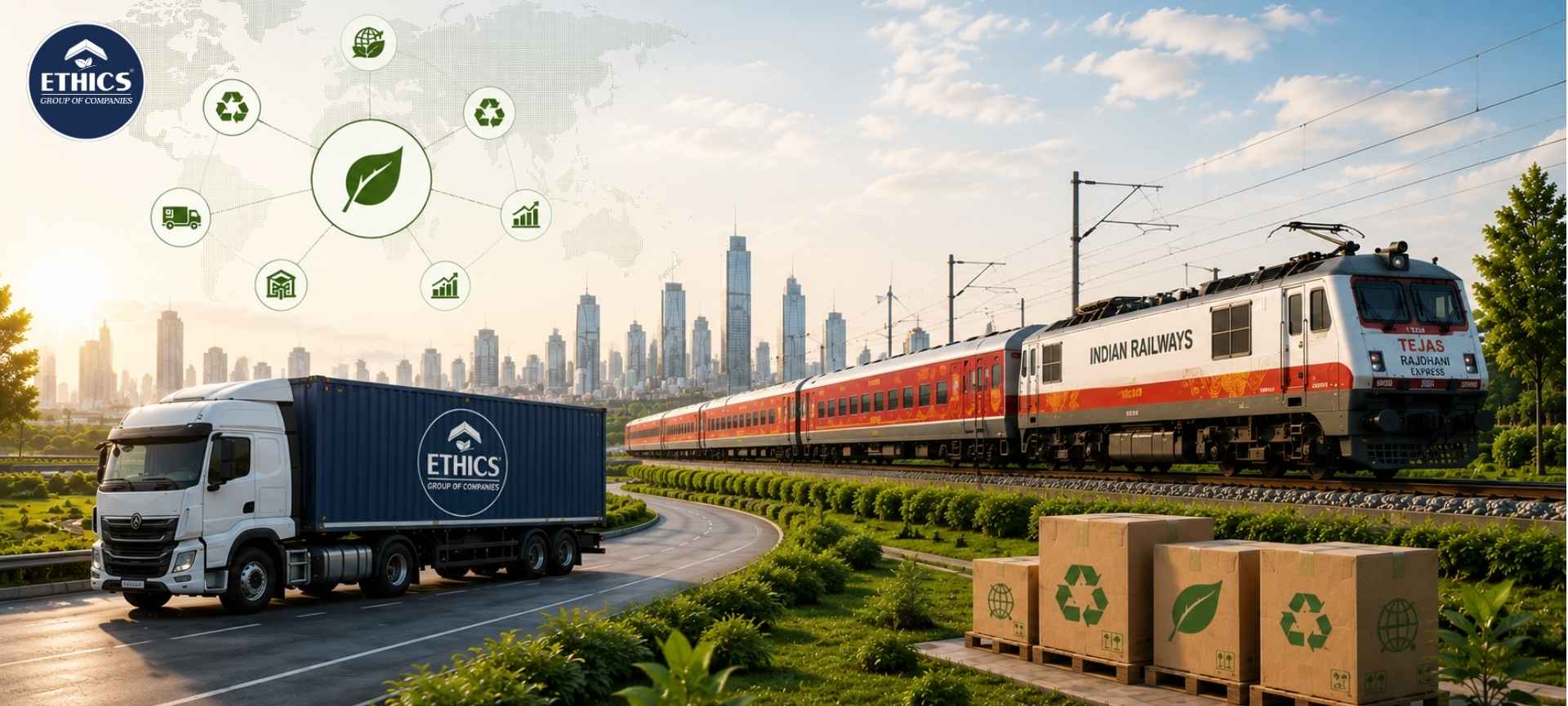
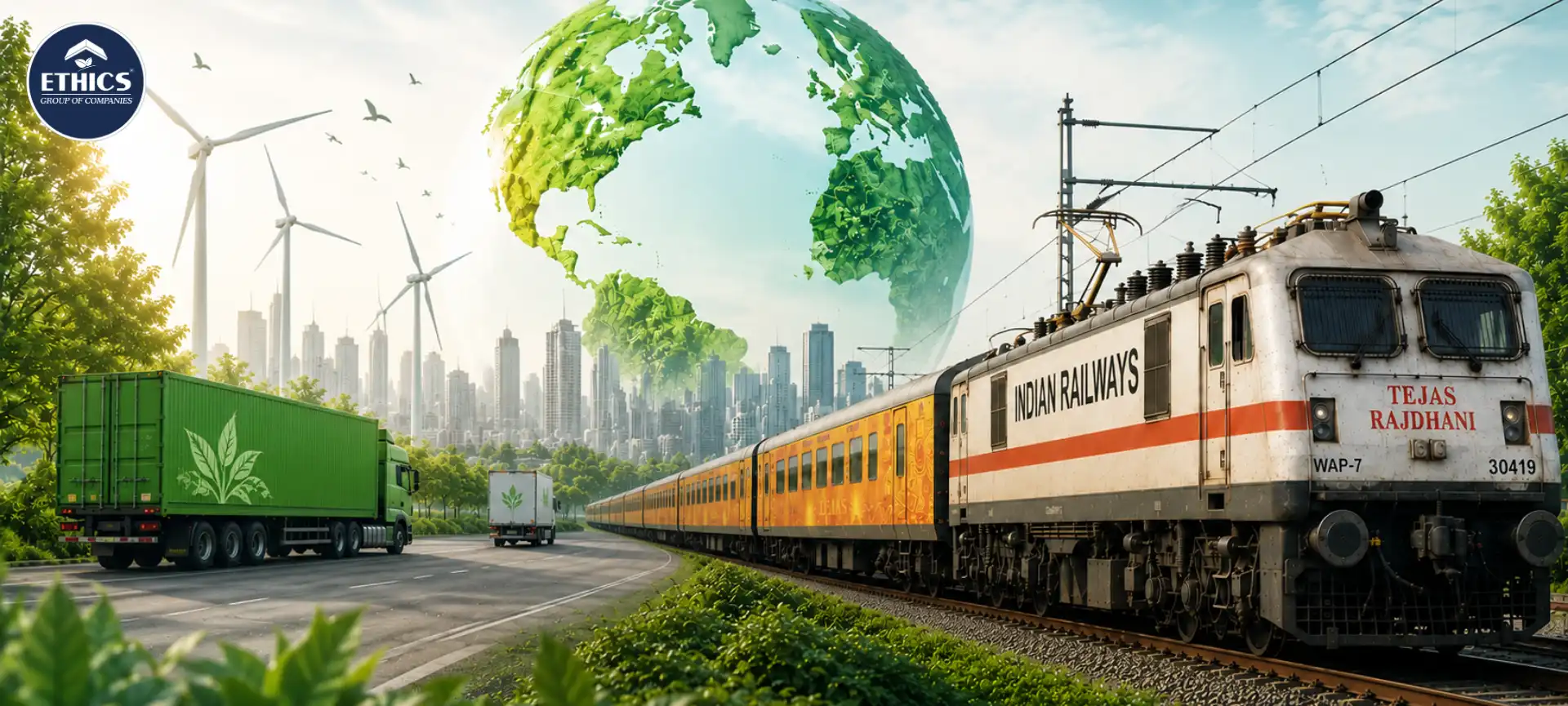
This is a principle we have put into practice. Through our logistics business, Ethics Group operates a dedicated rail parcel service on the Tejas Rajdhani Express (12951/12952) along the Delhi–Mumbai–Delhi corridor, running daily in both directions and supported by our own road network for the first and last mile. The design is deliberate: rail carries the long trunk, where the emissions saving is greatest, and road completes the journey to the customer's door. It is delivered by a team with over two decades of experience in railway parcel services across India.
This is what we mean by sustainability that is measurable rather than declared — a concrete service that lowers the carbon intensity of a major freight lane while meeting the cost and reliability that businesses require.
A measurable lever, not a slogan
Carbon is steadily moving from a voluntary commitment to a measured expectation. Larger buyers now ask suppliers to report the emissions of their logistics, sustainability targets are being written into contracts, and businesses trading with regulated export markets are moving toward formal carbon accounting. A shipper able to demonstrate a lower-carbon mode choice on a major corridor is not only reducing real emissions but also staying ahead of where procurement is heading. We believe responsible supply chains are built collaboratively, working with partners and stakeholders to raise standards and execute consistently.
Delivering more than logistics
For Ethics Group of Companies, sustainability means building supply chains that are efficient, responsible, and capable of delivering long-term value. The carbon comparison on the Delhi–Mumbai corridor is a clear illustration of how a single, well-informed decision can serve all three.
To explore how a lower-carbon, rail-led approach could work for your freight, visit our Logistics and Sustainability pages, or partner with us.