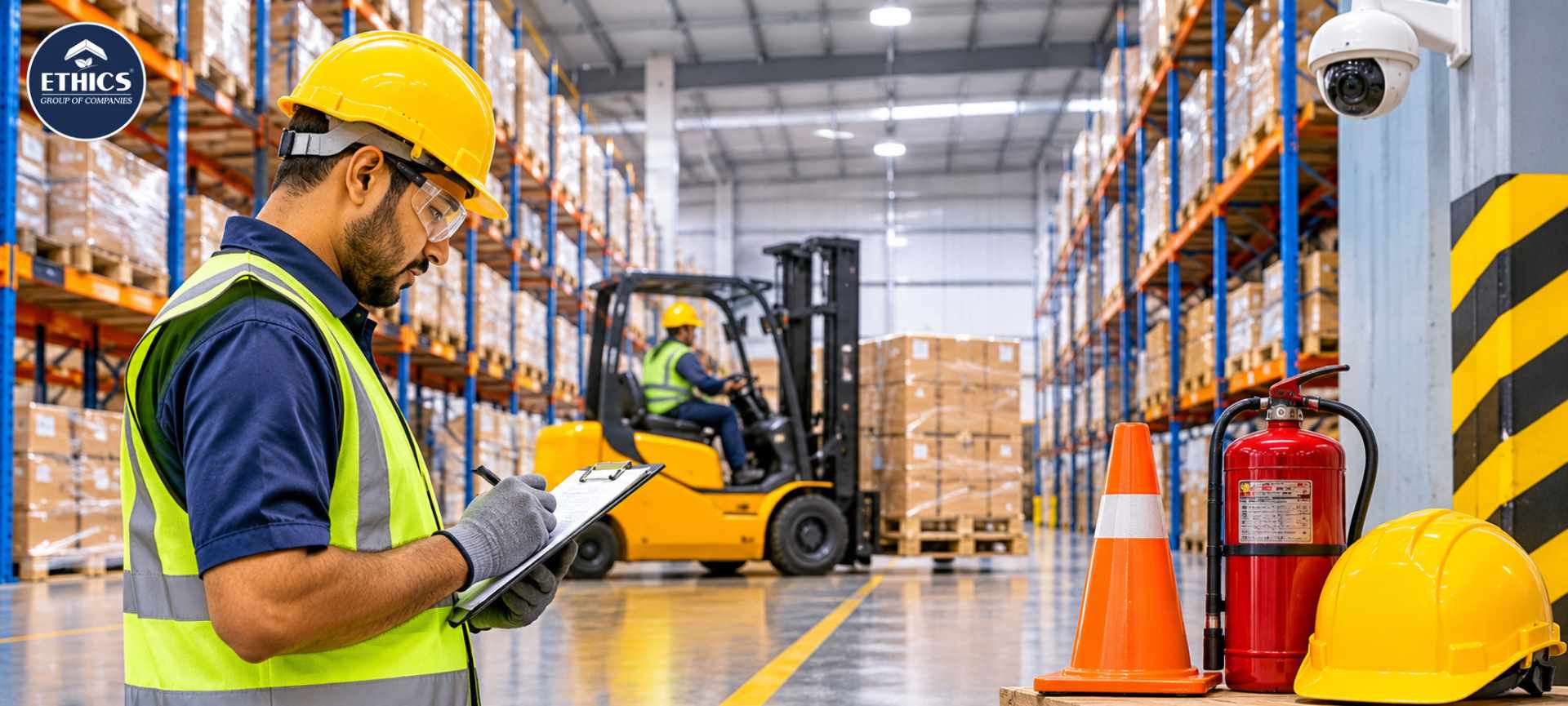

A forklift reverses at a blind aisle end. A rack beam takes a hit that nobody reports. A phone charger sits beside stacked cartons. Warehouses rarely have accidents out of nowhere. They have a chain of small, tolerated risks.
Supply chain management teams measure speed and cost closely. Safety is often measured only after something goes wrong. This guide sets out the warehouse safety standards every operator should follow in India: what the rules require, what good practice adds and how to audit your site.
Why Warehouse Safety Standards Are a Business Issue
The first cost is human. The business costs follow: stoppages, damaged stock, compensation, investigations and customer audits that go badly.
Incidents also travel. Safety failures ripple through the end to end supply chain, because a closed dock or a fire-damaged site delays every order behind it.
Finance should look at the whole cost, not only the visible part. Direct costs include injury, repair and lost stock. Indirect costs include downtime, overtime, retraining and lost contracts. Insurance matters too, since many warehouse insurance policies make fire-safety compliance a condition, and non-compliance can void claims. Check your own policy wording.
Large FMCG, pharma and e-commerce customers increasingly audit safety before awarding or renewing business. A weak record can cost you the contract.
What Rules Apply to Warehouses in India?
|
Area |
Framework |
Practical implication |
|
Worker safety, health and welfare |
OSH Code, 2020, with Central and State Rules |
Registration, safety organisation, welfare and reporting duties |
|
Fire and life safety |
NBC 2016 Part 4, state fire laws, Fire NOC |
Design, equipment, exits and periodic compliance |
|
Storage fire safety |
BIS code of practice for general storage and warehousing, including cold storages |
Stack heights, compartmentation and protection design |
|
Customer and insurer requirements |
Contracts, audit protocols, policy conditions |
Often stricter than the statutory minimum |
The legal ground has shifted. The OSH Code replaced 13 central laws, including the Factories Act, 1948 and the Contract Labour (Regulation and Abolition) Act, 1970. It was enforced from 21 November 2025, with the Central Rules notified on 8 May 2026. States are issuing their own rules too. For example, Andhra Pradesh issued its Rules on 6 August 2026.
Which obligations apply to your site depends on its size, activity and state. Confirm with your legal or EHS adviser, and pay particular attention to contract-labour responsibilities if you use contractors.
Core Warehouse Safety Standards Every Operator Must Follow
Fire Safety
Fire safety in warehouses starts with design and then depends on daily discipline.
Design: Detection and alarms, sprinkler protection matched to the commodity and storage height, hydrants, extinguishers, protected exits with clear travel routes and emergency lighting, as required by NBC Part 4 (Fire and Life Safety) and your Fire NOC. The BIS storage code was revised, and it changed permitted stack heights and compartment sizes.
Discipline: Clear packaging waste daily, check electrical loads and inspect panels for heat, restrict battery charging to ventilated, designated areas, enforce hot-work permits and segregate flammables, aerosols and lithium batteries. Racking changes need care too, since new rack runs must not block hose reels, hydrant valves, exits or the routes to them.
Forklift and Dock Safety
-
Authorise operators: Only trained, assessed and authorised staff drive, with refresher training.
-
Pre-shift checks: Brakes, steering, horn, lights, forks and seat belts, recorded daily.
-
Separate people and trucks: Marked pedestrian walkways, controlled crossing points and physical barriers where traffic is heavy.
-
Warn at blind spots: Mirrors, audible alarms and blue-light projection at aisle ends.
-
Respect load limits: Check the capacity plate. Never lift people on forks.
-
Secure the dock: Wheel chocks or vehicle restraints, dock plates in good order and edge protection. Trailer movement at the dock is a common source of serious injury.
Racking, Storage and Housekeeping
-
Display load capacity: Fit load plates and never exceed beam ratings.
-
Install and inspect properly: Use qualified installers and inspect regularly for damage, with a clear reporting and repair process.
-
Protect uprights: Column guards, like the yellow-and-black ones common on well-run sites, absorb impacts. Replace damaged uprights promptly.
-
Stack safely: Follow height and stability limits, and keep pallets in good condition.
-
Keep clear: Aisles, exits, fire equipment and electrical panels must never be blocked.
People: PPE, Training, Heat and Handling
-
Match PPE to the task: Hard hats in racking and overhead-load zones, high-visibility vests, safety footwear, gloves and eye protection where needed. A blanket rule that nobody believes in is weaker than a clear, enforced one.
-
Induct and retrain: Cover hazards, emergency procedures and reporting before the first shift. Repeat regularly.
-
Manage heat: Indian summers make heat stress a real risk. Provide ventilation, water and rest breaks, especially in sheds and non-air-conditioned docks.
-
Reduce manual handling: Use lifting aids and set weight limits.
Emergency Preparedness
Display evacuation plans, mark assembly points, appoint and train fire wardens and keep first-aid supplies stocked. Run drills regularly, review them honestly and record every incident and near miss. Near-miss reporting is the cheapest early warning you have.
Where Technology Helps (and Where It Adds Risk)
A warehouse management system supports safety indirectly. It can keep hazardous goods in approved zones, direct putaway to prevent overloaded locations and create an audit trail of movements and exceptions.
Warehouse automation takes people out of some risky tasks but adds new ones. Guarding, interlocks, lockout procedures and fire design for dense automated storage need specialist attention.
Cameras, forklift proximity sensors, thermal imaging and computer-vision tools for PPE and zone monitoring are also spreading. Treat them as aids to supervision, not substitutes. Electrification matters as well. The revised BIS storage code includes safety provisions for battery-operated forklifts, so review your charging areas
Safety in Outsourced Warehouses
In 3PL warehousing, safety accountability is shared and easily blurred. Write it into the contract: who owns fire compliance, training, incident reporting and contractor workforce obligations, and what audit rights you hold. Ask for the site's incident history and its last audit findings, not just policies.
A Practical Warehouse Safety Audit Checklist
When shortlisting supply chain management companies in India, or auditing your own sites, use a structured checklist.
|
Area |
What to check |
Suggested frequency |
|
Fire systems |
Detection, sprinklers, hydrants, extinguishers, NOC validity |
Per statutory schedule; internal checks regularly |
|
Exits and aisles |
Clear, marked and lit |
Daily |
|
Forklifts |
Pre-shift checks, operator authorisation, speed and traffic rules |
Daily; formal review monthly |
|
Racking |
Damage, load plates, column guards |
Weekly walk-through; formal inspection periodically |
|
Electrical and charging |
Panels, wiring, charging area |
Monthly |
|
Dock |
Restraints, plates, edge protection |
Daily |
|
PPE and training |
Availability, use, records |
Monthly |
|
Emergency |
Drills, wardens, first aid |
Per plan; review after each drill |
|
Incidents |
Near-miss logs and closure of actions |
Monthly review |
Track results with a few leading and lagging measures: near misses reported, audit actions closed on time, forklift incidents and lost-time injuries. Treat rising near-miss reports as a sign of a healthy reporting culture, not a failing site.
Conclusion
Warehouse safety standards work when they are specific, enforced and audited, not when they sit in a manual. Start with the legal baseline, close the biggest physical risks first and make reporting easy.
Ethics Group works with businesses to turn safety requirements into practical site procedures, audits and partner standards across warehousing operations.





.jpg)