
A pallet of dairy sits at the back of a pick face for three weeks while newer stock ships out first. Nobody notices until the monthly write-off report arrives.
Stock rotation sounds like housekeeping. In supply chain management, it is a margin decision, because it decides whether inventory leaves the building as revenue or as waste.
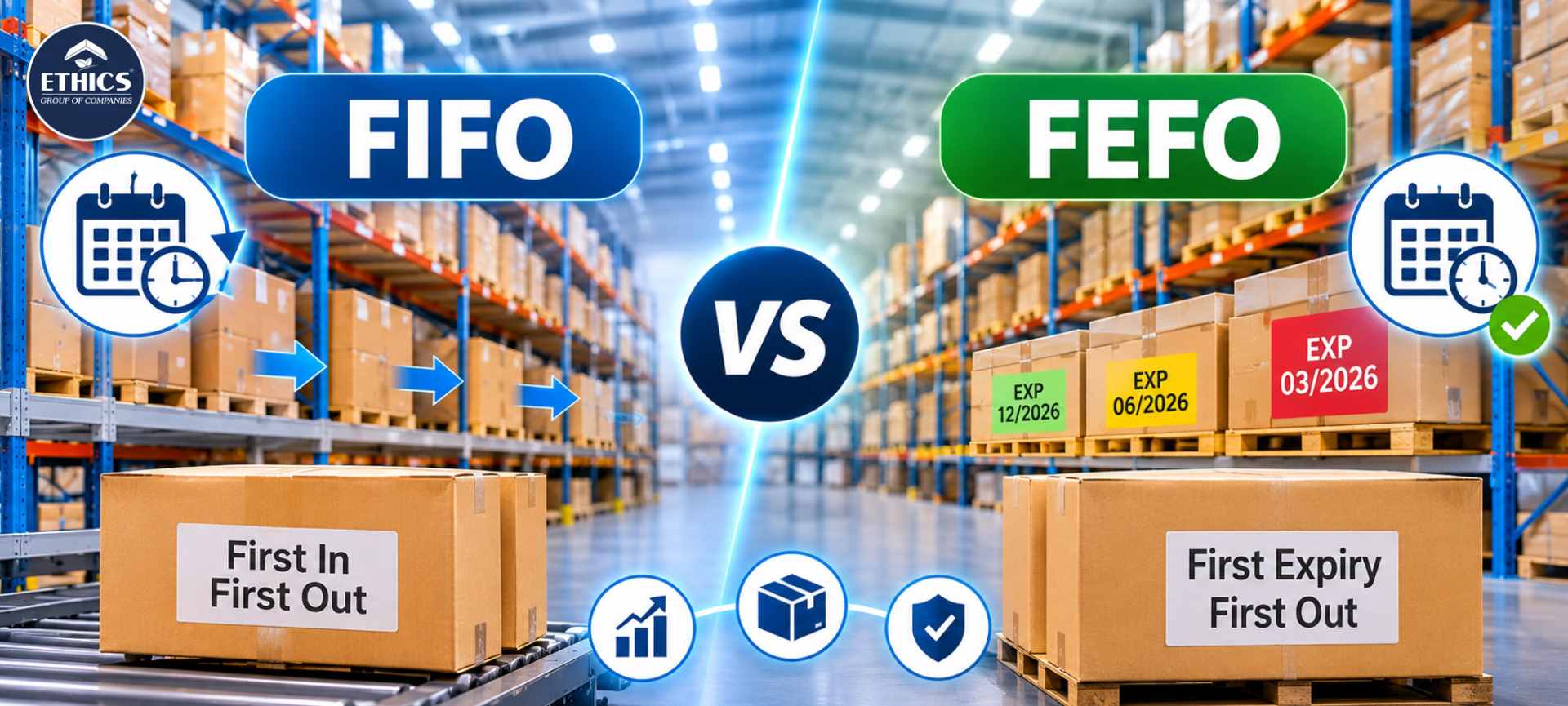
This guide explains FIFO vs FEFO in practical terms: what each method does, where each belongs, what each costs to run and how to implement the right one.
What Is FIFO (First In, First Out)?
FIFO means the oldest stock, measured by receipt date, is picked and shipped first. The assumption is that older stock is also the stock closest to the end of its useful life.
That assumption holds when products have uniform shelf life or no expiry, as with most durable goods, packaging and spare parts. Rotation is simple: store new stock behind or beneath old stock, and pick from the front.
One point of clarity. FIFO is also an accounting cost formula used for valuing inventory. Physical rotation and cost valuation are separate decisions, and a warehouse can rotate by FEFO while finance values stock on another permitted basis. In India, finance teams commonly use FIFO or weighted average cost, but confirm your policy with your finance team.
What Is FEFO (First Expired, First Out)?
FEFO means stock with the earliest expiry date is picked first, regardless of when it arrived.
This matters when batches arrive with different remaining shelf lives. Suppose a newer batch has a shorter expiry than the older one, perhaps from a different plant or supplier lot. Under FIFO, the longer-dated older batch ships first, and the shorter-dated batch may expire in the rack. FEFO ships the batch that will expire first.
FEFO depends on data. The system must capture batch and expiry at receipt, and the floor must pick against that data instead of by sight.
FIFO vs FEFO: Key Differences
|
Factor |
FIFO |
FEFO |
|
Rotation basis |
Date received |
Expiry date |
|
Data needed |
Receipt date or sequence |
Batch, lot and expiry date per unit |
|
Best for |
Non-perishable, uniform-life goods |
Perishable, expiry-sensitive and regulated goods |
|
Main risk addressed |
Stock ageing, obsolescence |
Expiry write-offs, short-dated dispatch, recalls |
|
System need |
Basic; can run on discipline and layout |
Batch and expiry tracking, directed picking |
|
Operational effort |
Lower |
Higher, especially with mixed batches |
|
Typical failure |
Shorter-dated stock stranded behind longer-dated stock |
Wrong batch picked when systems and floor drift apart |
Neither method is "better". The question is which risk is costlier for your product: ageing in general, or expiring in particular.
When to Use FIFO and When to Use FEFO
Use FIFO When
-
Products do not expire, or expiry is far beyond your stock-holding period.
-
Shelf life is uniform across batches.
-
Obsolescence follows receipt order, as with many spare parts, packaging and accessories.
-
Systems and labour are simple, and the risk of mis-picks outweighs the benefit of finer control.
Use FEFO When
-
Products carry batch-level expiry or shelf-life limits, such as pharmaceuticals, food, beverages, cosmetics and certain chemicals.
-
Customers set minimum remaining shelf life at delivery.
-
Regulations or audits require batch traceability and recall readiness.
This is why FEFO is standard practice in pharma logistics in India, where expiry control, batch records and recall readiness are audit expectations rather than choices.
In an FMCG supply chain, FEFO matters because retailers and modern-trade customers often specify minimum remaining shelf life at receipt, and the requirement differs by customer. Check each account's terms and build them into your pick rules.
Use a Mix When
Most warehouses hold both types of SKU. Assign the rule at SKU level, not site level: FEFO for expiry-controlled items, FIFO for the rest.
Benefits and Challenges of Each Method
FIFO
Benefits:
-
Simple to teach, audit and run.
-
Low systems burden.
-
Reduces general stock ageing.
Challenges:
-
Cannot prevent shorter-dated stock being shipped late.
-
Offers weak control where batch expiry varies.
-
Gives little protection in recall and audit scenarios.
FEFO
Benefits:
-
Reduces expiry write-offs and near-expiry dispatches.
-
Supports customer shelf-life commitments.
-
Provides batch traceability for recalls and audits.
Challenges:
-
Needs accurate batch and expiry capture at receiving.
-
Mixed expiry dates complicate slotting and picking.
-
Demands floor discipline, because one wrong pick can undo the system.
-
Raises handling effort and may cut storage density if batches are segregated.
On the finance side, an expiry write-off costs the stock value plus disposal and handling, and often a missed sale. FEFO programmes should track write-offs as a share of cost of goods sold, and compare them before and after implementation.
How to Implement FEFO or FIFO in Your Warehouse
-
Classify your SKUs. Mark each item as expiry-controlled (FEFO) or not (FIFO), and record shelf life and customer minimums.
-
Capture the data at receiving. Scan batch and expiry at goods receipt. Reject or flag stock that arrives with insufficient remaining life, according to agreed terms.
-
Use a system. A warehouse management system enforces the rule by directing pickers to the right batch and blocking expired or quarantined stock. Spreadsheets and visual checks break down at volume.
-
Design the layout. For FIFO, use flow racks, carton-flow or clearly marked front-loading. For FEFO, keep pick faces uniform in expiry where possible and avoid mixing batches in the same location.
-
Set near-expiry thresholds. Create alerts at agreed points, and define who decides on promotion, transfer, return or disposal.
-
Handle returns carefully. Re-inspect and re-slot returned stock according to its batch and remaining life. Never put it back into the live pick face automatically.
-
Apply client rules in outsourced sites. In 3PL warehousing, write customer-specific shelf-life and rotation rules into the service agreement and the system configuration, and audit them.
-
Check suppliers and partners. Many supply chain management companies in India offer FEFO-capable systems, but ask for a live demonstration using your batch and expiry data.
-
Count and audit. Run regular cycle counts and sample audits of pick compliance against system instructions.
-
Track the right KPIs. Monitor expiry write-off percentage, average remaining shelf life at dispatch, customer rejection for short life and FEFO or FIFO pick compliance.
Rotation rules also need to hold across the whole network. In an end to end supply chain, stock ages in the gaps between plants, depots, partner sites and distributors, so agree on rules and data handoffs at every node.
Conclusion
The FIFO vs FEFO choice comes down to what expires and who decides. Use FIFO where age is the main risk and the product holds its value. Use FEFO where batch expiry, customer shelf-life terms or regulation drive the decision.
Most businesses end up with both, assigned at SKU level and supported by clean data and a disciplined floor. Ethics Group works with businesses to set rotation rules, configure systems and audit execution across warehouses and partner sites.










.jpg)