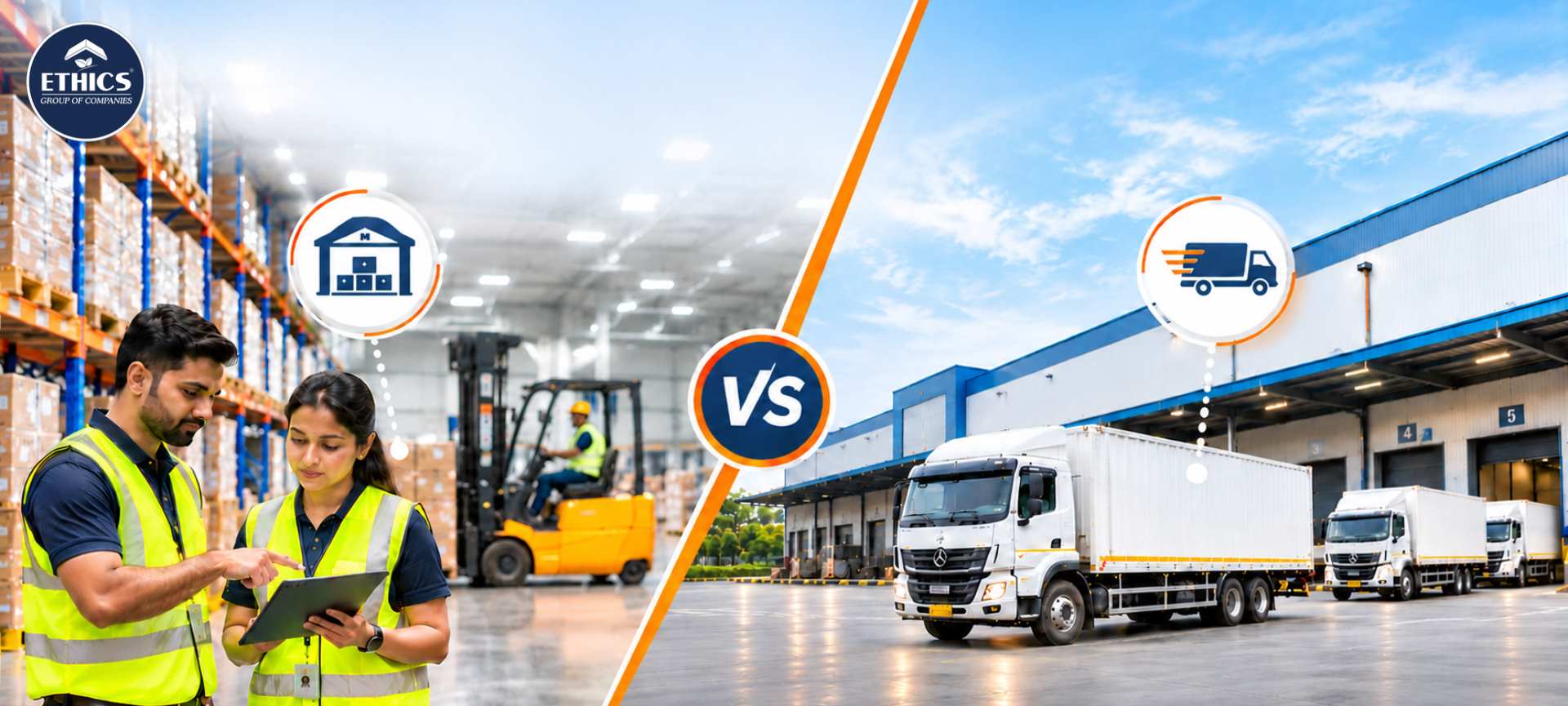
Supply chain management rarely offers a decision as consequential as this one: who runs your warehouses, fleets and systems? It shapes your cost structure, your service promise and how well you handle shocks.
Many Indian businesses decide by default. They outsource because a vendor pitched well, or keep everything in-house because it has always been done that way.
This guide compares the in-house vs outsourced supply chain models, shows where each wins, and offers a seven-factor framework for deciding.
What Do In-House and Outsourced Supply Chains Mean?
An in-house supply chain means your company owns or leases the assets, employs the people and runs the systems for warehousing, transport and related activities.
An outsourced supply chain means third parties, such as 3PL warehousing and transport providers, perform some or all of those activities under a contract with defined service levels.
Scope varies. Some businesses outsource only transport or one warehouse. Others hand over the full end to end supply chain.
It also helps to separate supply chain vs logistics before you decide. Many firms outsource logistics, meaning storage and movement, while keeping planning, sourcing and customer commitments in-house.
In-House Supply Chain: Pros and Cons
Advantages
-
Control: You set the processes, priorities and standards directly.
-
Customer and data proximity: Your team sees orders, returns and customer feedback first-hand.
-
Customisation: Workflows can be tailored to unusual products or service models.
-
Knowledge retention: Process expertise stays within your organisation.
-
Margin retention at scale: At high, stable volumes, you avoid paying a vendor margin.
Limitations
-
Capital intensity: Facilities, vehicles, racking and equipment tie up capital.
-
Fixed costs: Costs stay even when volumes fall.
-
Technology burden: You must buy and maintain a warehouse management system, transport tools and reporting, then keep them current.
-
Slower scaling: New cities and peaks need lead time for sites, hiring and training.
-
Management bandwidth: Leaders spend time on operations instead of the core business.
-
Compliance load: Labour, safety, licensing and audit responsibilities sit entirely with you.
Outsourced Supply Chain: Pros and Cons
Advantages
-
Variable cost: Many contracts convert fixed costs into costs that move with volume, easing balance-sheet pressure.
-
Speed to scale: Existing networks let you enter new regions or handle seasonal peaks faster.
-
Shared infrastructure: Multi-client sites can offer better utilisation than a single-client operation.
-
Specialist capability: Providers bring compliance, process discipline and technology you may lack.
-
Focus: Management can concentrate on products, brands and customers.
The model is widely used. 3PL companies were the largest occupiers of industrial and warehousing space in India’s top eight cities in H1 2026.
Limitations
-
Reduced direct control: Quality depends on a partner’s people and priorities.
-
Dependency and lock-in: Switching providers mid-contract can be costly and disruptive.
-
Service gaps: Poorly written service levels lead to disputes.
-
Data and integration: If you cannot see the provider’s data, you cannot manage the operation.
-
Vendor margin: You pay for the provider’s profit and overheads.
-
Cultural fit: Providers serving many clients may not match your urgency.
In-House vs Outsourced: Side-by-Side Comparison
|
Factor |
In-house |
Outsourced |
|
Cost structure |
Mostly fixed |
Fixed plus variable, depending on contract |
|
Capital need |
High (assets, systems) |
Low to moderate |
|
Control |
Direct and complete |
Contractual and indirect |
|
Speed to scale |
Slower |
Faster, subject to partner capacity |
|
Expertise and technology |
Must be built and maintained |
Accessed from the provider |
|
Compliance burden |
Fully yours |
Shared; ultimate accountability often remains yours |
|
Flexibility in peaks |
Limited |
Higher |
|
Best suited for |
Stable volumes, proprietary processes |
Variable volumes, fast expansion, specialist needs |
No row in this table decides the question alone. The right answer comes from weighing them against your own business.
7 Factors to Decide Which Model Fits Your Business
-
Strategic importance. If a function differentiates you, such as a proprietary cold chain, lean towards control. If it is a commodity activity, lean towards outsourcing.
-
Volume and predictability. Stable, high volumes favour in-house or dedicated operations. Volatile or seasonal volumes favour outsourcing. An FMCG supply chain with sharp promotional peaks often keeps a core in-house and buys overflow capacity.
-
Cost and capital. Compare three- to five-year total cost, including management time, systems, compliance and idle capacity, not just the visible rate. Ask finance to apply your actual cost of capital.
-
Compliance and service requirements. Pharma logistics in India demands licensed, validated and audit-ready storage, which many businesses find easier to buy than to build. Regulated and high-value goods deserve a hard look at partner credentials.
-
Network complexity and reach. Multi-city distribution, port connectivity and multimodal freight transport need partners with relationships and volumes you may not have alone.
-
Technology and data. Insist on supply chain visibility, through APIs or shared dashboards, whichever model you choose. If you cannot see, you cannot control.
-
Risk and resilience. Today’s supply chain challenges, from route disruption to container shortages, test partners as much as your own team. Check financial stability, redundancy, contingency plans and exit terms.
The Hybrid Model and How to Outsource Successfully
How a Hybrid Model Works
Most mature businesses end up in the middle. Hybrid arrangements are a recurring theme in current supply chain trends, because they balance control and flexibility.
A typical split:
-
Keep in-house: Planning, customer service, strategic inventory decisions and key accounts.
-
Outsource: Overflow warehousing, specific transport lanes, last-mile delivery and temperature-controlled storage.
You can also run a dedicated partner site for stable volumes and shared capacity for peaks.
How to Outsource Successfully
-
Define scope and baseline. Map your network from sourcing to last-mile and record current cost, service level and error rates. You cannot judge a provider against a baseline you do not have.
-
Select on capability, not rate. Visit sites, check references and test with your own data.
-
Structure the commercials. Options include fixed-plus-variable pricing, open-book arrangements and gain-share on improvements. Align incentives to outcomes.
-
Write measurable service levels. Use KPIs such as OTIF, inventory accuracy and dock-to-stock time, with clear remedies.
-
Protect data and integrate systems. Define data ownership, system access and reporting before go-live.
-
Set governance. Hold regular reviews and joint improvement plans, not only penalty discussions.
-
Plan the exit. Agree transition support, step-in rights and notice periods up front. Confirm labour-law and principal-employer obligations with your legal team.
Conclusion
There is no universally correct answer in the in-house vs outsourced supply chain debate. The right model depends on strategic importance, volume stability, cost of capital, compliance needs and appetite for risk.
Many businesses do best with a hybrid, started small and expanded as the partnership proves itself. Ethics Group works with businesses to assess these trade-offs and design the operating model that fits their network and growth plans.