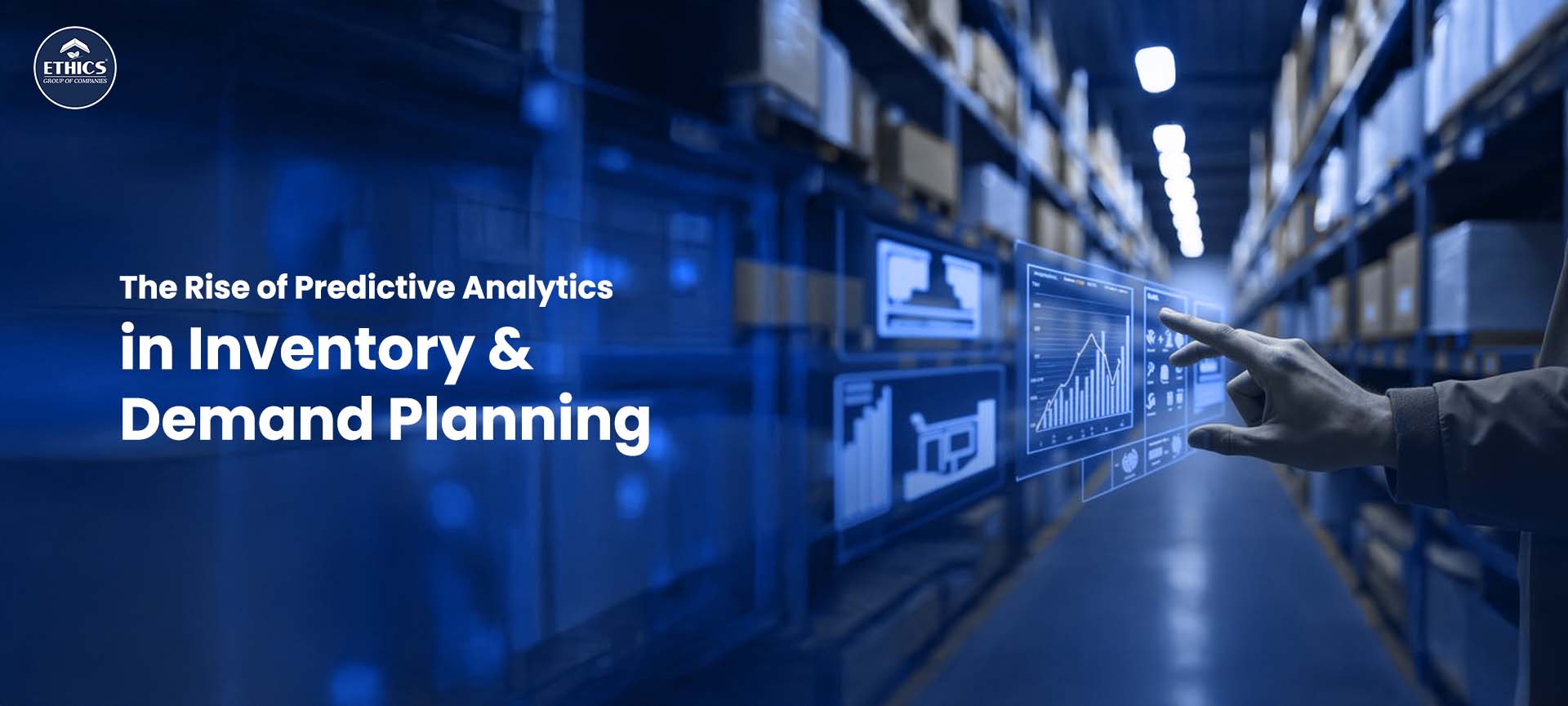
In today’s dynamic and customer-driven marketplace, businesses are under constant pressure to maintain optimal inventory levels while ensuring product availability. Traditional forecasting methods, often reliant on historical data and manual estimations, are no longer sufficient to address the complexities of modern supply chains. This is where predictive analytics is transforming inventory and demand planning.
Predictive analytics leverages advanced technologies such as Artificial Intelligence (AI), Machine Learning (ML), and Big Data to forecast future demand with remarkable accuracy. For organizations striving to enhance operational efficiency and customer satisfaction, adopting predictive analytics is no longer optional—it is a strategic necessity.
At Ethics Group, we recognize the transformative potential of data-driven decision-making in building resilient and agile supply chains. This blog explores how predictive analytics is reshaping inventory and demand planning, its key benefits, real-world applications, and best practices for implementation.
Understanding Predictive Analytics in Supply Chain
Predictive analytics refers to the use of statistical algorithms, data mining techniques, and machine learning models to analyze historical and real-time data, enabling businesses to forecast future outcomes. In the context of inventory and demand planning, it helps organizations anticipate customer demand, optimize stock levels, and minimize operational risks.
Key Components
- Data Collection: Aggregating data from ERP systems, sales channels, IoT devices, and market trends.
- Data Processing: Cleaning and structuring data to ensure accuracy and reliability.
- Predictive Modeling: Applying machine learning algorithms to identify patterns and forecast demand.
- Actionable Insights: Translating predictions into strategic decisions for procurement, production, and distribution.
Why Traditional Forecasting Falls Short
Traditional demand planning methods often rely on spreadsheets and historical averages. While useful in stable environments, these approaches struggle to adapt to rapid market fluctuations, seasonal variations, and unexpected disruptions.
Limitations of Conventional Methods
- Limited Accuracy: Inability to account for real-time variables such as weather, promotions, or economic shifts.
- Reactive Decision-Making: Decisions are based on past events rather than future possibilities.
- Manual Intervention: High dependency on human judgment increases the risk of errors.
- Lack of Scalability: Difficulty in managing large datasets across multiple channels.
Predictive analytics addresses these challenges by providing proactive, data-driven insights, enabling organizations to stay ahead of demand fluctuations.
Key Benefits of Predictive Analytics in Inventory & Demand Planning
1. Enhanced Forecast Accuracy
Predictive models analyze vast datasets to identify hidden patterns and trends, significantly improving demand forecast accuracy. This leads to better alignment between supply and demand.
2. Optimized Inventory Levels
By accurately predicting demand, businesses can maintain optimal stock levels, reducing both overstocking and stockouts. This balance minimizes carrying costs while ensuring product availability.
3. Reduced Operational Costs
Efficient inventory management lowers warehousing, transportation, and obsolescence costs. Predictive analytics also streamlines procurement and production planning.
4. Improved Customer Satisfaction
Timely product availability enhances service levels and customer trust, leading to stronger brand loyalty and competitive advantage.
5. Risk Mitigation
Predictive analytics helps identify potential disruptions, such as supplier delays or sudden demand spikes, enabling proactive contingency planning.
6. Data-Driven Decision Making
Organizations gain actionable insights that support strategic planning and long-term business growth.
Real-World Applications Across Industries
1. Retail & E-Commerce
Retailers use predictive analytics to forecast seasonal demand, manage promotions, and optimize replenishment cycles. This ensures shelves remain stocked with the right products at the right time.
2. Pharmaceuticals & Healthcare
In the pharmaceutical sector, accurate demand forecasting is critical for ensuring the availability of life-saving medicines while minimizing wastage due to expiration.
3. FMCG (Fast-Moving Consumer Goods)
FMCG companies leverage predictive analytics to manage high-volume, fast-moving inventories, enabling efficient distribution and reduced stockouts.
4. Automotive & Manufacturing
Manufacturers use predictive insights to align production schedules with market demand, reducing lead times and improving supply chain efficiency.
Technologies Powering Predictive Analytics
1. Artificial Intelligence (AI) and Machine Learning (ML)
AI and ML algorithms continuously learn from data, improving forecast accuracy over time and adapting to changing market conditions.
2. Internet of Things (IoT)
IoT devices provide real-time visibility into inventory levels and supply chain movements, enhancing predictive capabilities.
3. Cloud Computing
Cloud platforms enable scalable data storage and processing, allowing businesses to analyze large datasets efficiently.
4. Big Data Analytics
The integration of structured and unstructured data sources provides a comprehensive view of demand patterns.
5. Advanced Planning Systems (APS)
APS solutions integrate predictive analytics with supply chain planning, enabling end-to-end optimization.
Best Practices for Implementing Predictive Analytics
1. Establish a Strong Data Foundation
Ensure data accuracy and consistency by integrating information from ERP, WMS, TMS, and other enterprise systems.
2. Define Clear Business Objectives
Align predictive analytics initiatives with organizational goals such as cost reduction, service level improvement, or inventory optimization.
3. Invest in the Right Technology
Select scalable and flexible analytics platforms that can integrate seamlessly with existing systems.
4. Foster Cross-Functional Collaboration
Encourage collaboration between supply chain, IT, sales, and finance teams to ensure successful implementation.
5. Start with Pilot Projects
Begin with small-scale implementations to validate models before scaling across the organization.
6. Continuous Monitoring and Improvement
Regularly evaluate model performance and update algorithms to maintain accuracy and relevance.
Challenges and How to Overcome Them
1. Data Silos
Solution: Implement integrated data platforms to ensure seamless information flow across departments.
2. Skill Gaps
Solution: Invest in training programs and collaborate with analytics experts to build internal capabilities.
3. High Initial Investment
Solution: Adopt cloud-based solutions that offer scalability and cost efficiency.
4. Change Management
Solution: Promote a data-driven culture and secure leadership buy-in to drive organizational adoption.
The Future of Predictive Analytics in Supply Chains
The adoption of predictive analytics is expected to accelerate as supply chains become increasingly digital and interconnected. Emerging trends include:
- Prescriptive Analytics: Moving beyond predictions to recommend optimal actions.
- Digital Twins: Simulating supply chain scenarios for enhanced decision-making.
- Autonomous Supply Chains: Leveraging AI to automate planning and execution.
- Sustainability Optimization: Predicting demand to reduce waste and carbon emissions.
Organizations that embrace these advancements will gain a significant competitive edge in the evolving business landscape.
How Ethics Group Enables Predictive Supply Chains
At Ethics Group, we empower businesses with end-to-end supply chain solutions that integrate advanced analytics, real-time visibility, and strategic planning. Our expertise in logistics, warehousing, and distribution enables organizations to harness the full potential of predictive analytics.
Our Key Capabilities
- Integrated Supply Chain Solutions
- Technology-Driven Inventory Management
- Real-Time Visibility and Tracking
- Scalable Warehousing and Distribution
- Customized Demand Planning Strategies
By partnering with Ethics Group, businesses can transform their supply chains into agile, resilient, and data-driven ecosystems.
Conclusion
Predictive analytics is revolutionizing inventory and demand planning by enabling organizations to anticipate market dynamics and make proactive decisions. From enhancing forecast accuracy to optimizing inventory and improving customer satisfaction, its benefits are far-reaching.
As supply chains continue to evolve, businesses that adopt predictive analytics will be better positioned to navigate uncertainties and achieve sustainable growth. With its deep industry expertise and technology-driven approach, Ethics Group stands as a trusted partner in this transformative journey.




.jpg)