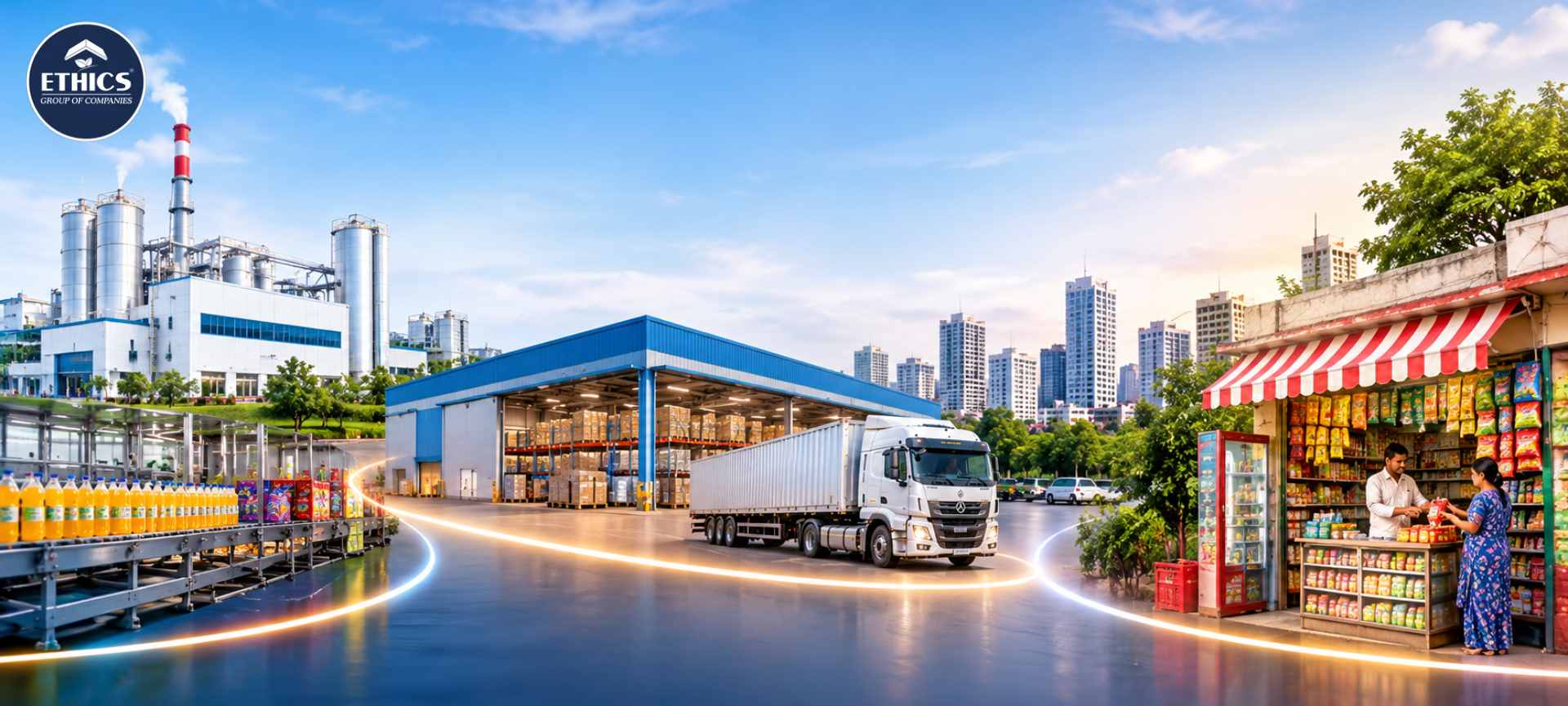
A packet of biscuits leaves a factory in one state and reaches a village shelf three days later. In between sit a depot, a distributor, perhaps a wholesaler and a delivery vehicle that may or may not have been full.
FMCG distribution is where margin is made and lost. Supply chain management for consumer goods is largely a distribution problem: thousands of SKUs, millions of outlets, thin margins and short shelf lives.
This guide explains how FMCG distribution works in India, from factory to kirana, how the channels differ, what goes wrong and how to build a network that holds up.
The Big Picture: How FMCG Products Reach Indian Consumers
Indian distribution is unusual in its fragmentation. General trade, led by kirana stores, is still the backbone, though estimates of its share differ. A Commerce Ministry statement describes over 1.4 crore kirana stores contributing nearly 75–80% of FMCG sales, while one market study puts general trade and kirana at 64% of 2025 value. Definitions and scope explain much of the gap.
Newer channels are growing from a smaller base. NielsenIQ reports e-commerce at 7% of FMCG sales nationally. For listed FMCG companies, e-commerce is 8–15% of domestic revenue, with 50–70% of that flowing through quick commerce.
The practical point is that one FMCG supply chain now serves very different customers: a village retailer ordering weekly on credit, a supermarket chain with strict delivery slots and a dark store that replenishes daily. One network design cannot serve all three equally well.
The Distribution Chain Step by Step: Factory to Kirana
The traditional general-trade route has three to four layers between the company and the customer: the C&F agent, distributor, wholesaler and retailer. Distribution from the company to the distributor is called primary. Distribution from the distributor to the retailer is called secondary.
|
Stage |
Role |
Typical pain point |
|
Factory or plant |
Produces and dispatches in full truck loads |
Production plans that drift from real demand |
|
C&F agent or mother warehouse |
Holds bulk stock and serves a state or region |
Stock imbalance across depots |
|
Distributor or stockist |
Holds local stock and delivers to retailers |
Capital, credit and claims |
|
Wholesaler or sub-stockist |
Breaks bulk for small retailers, especially rural |
Thin visibility for the brand |
|
Retailer (kirana, modern trade store) |
Sells to the consumer |
Small, frequent orders and limited shelf space |
Long plant-to-depot lanes increasingly mix road with rail or coastal legs. Multimodal freight transport suits bulk, non-urgent replenishment, while urgent flows stay on road.
The distributor is the critical link. Distributors fund inventory and outlet credit, and distributors operate on credit, so payment delays and stock problems travel upstream quickly.
Channels: General Trade, Modern Trade, E-Commerce and Quick Commerce
|
Channel |
Order profile |
Service expectation |
Main challenge |
|
General trade (kirana, wholesale) |
Small, frequent, often on credit |
Regular beat coverage |
Cost-to-serve and credit risk |
|
Modern trade |
Large, scheduled orders |
Strict delivery slots, minimum shelf life |
OTIF penalties and chargebacks |
|
E-commerce |
Smaller SKU-level orders |
Accurate packaging and fast dispatch |
Returns and packaging cost |
|
Quick commerce |
Small, high-frequency replenishment to dark stores |
Speed and consistent availability |
Price discipline and channel conflict |
Channel conflict is real. Distributor bodies have taken their concerns about quick commerce to the Competition Commission of India. Brands must balance new growth with the distributors who still serve most outlets.
Key Challenges in FMCG Distribution
-
Cost-to-serve: Delivering small drops to many outlets is expensive, and averages hide loss-making routes and channels.
-
Distributor working capital: Credit to outlets and slow claim settlement strain distributor finances, which can limit coverage.
-
Forecasting and stock imbalance: Promotions and SKU proliferation create stockouts in one depot and excess in another.
-
Shelf life and returns: Expiry-led returns and near-expiry stock erode margin. FEFO discipline must hold across every node.
-
Limited visibility: Brands often cannot see secondary sales or distributor stock in real time.
-
Channel conflict: Different prices and terms across channels create disputes and claim leakage.
-
Rural and seasonal reach: Monsoon, festive peaks and poor last-mile roads make service levels uneven.
How Technology Is Changing FMCG Distribution
-
Distributor management systems: Capture secondary sales, stock and claims, giving brands visibility beyond the primary sale.
-
Sales force automation: Digitises beat plans, order capture and outlet data.
-
Retailer ordering and B2B platforms: Move kirana ordering from visits to apps. The Commerce Ministry has discussed DigiDukaan, a plan to digitise India's 1.4 crore kirana stores.
-
Depot systems: A warehouse management system gives location-level stock accuracy, FEFO enforcement and faster picking at depots and hubs.
-
Automation where volumes justify it: Warehouse automation, such as sorters or conveyors, makes sense at high-throughput hubs and quick-commerce-facing sites. It does not make sense at low-volume depots.
-
Analytics: Demand sensing, route optimisation and control towers help balance stock and spot delays earlier.
Technology works only on clean data. Fix outlet, SKU and distributor master data first.
Building an Efficient Distribution Network: Best Practices
-
Segment outlets and channels. Rank by cost-to-serve and growth, then assign service models: direct, distributor-led, wholesale or digital.
-
Rationalise nodes. Review depot count and location against demand density and delivery frequency.
-
Plan distribution and warehousing together. Depot location and capacity set your delivery frequency and cost, so decide them as a pair.
-
Build channel-specific flows. Create dedicated picking and slotting for modern trade and quick commerce.
-
Use flexible capacity. 3PL warehousing can handle peaks and new regions without long commitments, as long as service levels and data access are in the contract.
-
Strengthen distributor economics. Share visibility, speed up claims and review return on investment for distributors, since weak distributors weaken coverage.
-
Manage shelf life. Enforce FEFO and set minimum remaining shelf life at dispatch for each customer.
-
Measure what matters. Track OTIF, fill rate, cost per case, days of inventory and distributor return on investment.
-
Choose partners carefully. When evaluating supply chain management companies in India, ask for results in your category, site audits and data-sharing terms.
-
Pilot before scaling. Test network changes on one region or channel first.
Treat all of this as one end to end supply chain, from plant planning to retailer delivery, so a change in one layer is tested against the others.
Conclusion
FMCG distribution in India rewards reach, discipline and data. The winners segment their channels, keep distributors financially healthy and invest in visibility before automation.
Start with cost-to-serve, fix master data and pilot changes before scaling them. Ethics Group works with consumer-goods businesses to design and run distribution networks that balance reach, cost and service.